When the Orchestra Meets the Silver Screen: How Film Composers Are Rewriting the Rules of Classical Music
For much of the twentieth century, the relationship between Hollywood and the concert hall was cordial but carefully managed — a kind of genteel mutual acknowledgment that preserved the social distance between popular entertainment and high art. Film scores were admired for their craft, occasionally performed at pops concerts as crowd-pleasing novelties, and then returned to their proper place in the cultural hierarchy: below the symphony, above the jingle.
That arrangement, always somewhat artificial, has now collapsed entirely. And the consequences are proving far more interesting than anyone on either side of the divide might have predicted.
A New Kind of Composer Enters the Hall
The figures driving this transformation are, on the surface, an unlikely cohort of classical revolutionaries. Hans Zimmer, the German-born composer whose scores for Inception, Interstellar, and Dune have become touchstones of contemporary sonic imagination, has in recent years mounted arena and concert hall tours that sold out venues across the United States with a speed more typically associated with rock musicians than composers of orchestral music. Ludwig Göransson, the Swedish-born composer who won Academy Awards for his scores for Black Panther and Oppenheimer, has seen his concert hall profile rise in parallel with his cinematic reputation, with major American orchestras programming his work alongside Beethoven and Brahms without apparent embarrassment.
What distinguishes these composers from earlier generations of film-to-concert crossover figures — Bernard Herrmann, say, or John Williams, whose work has long been embraced by symphony orchestras — is not merely the scale of their popular success. It is the nature of their compositional language. Zimmer and Göransson, along with figures such as Ennio Morricone's spiritual heirs and composers like Hildur Guðnadóttir, work in an idiom that is neither conventionally classical nor straightforwardly popular. It borrows freely from minimalism, from electronic music, from world music traditions, and from the full orchestral palette of the Western canon, synthesizing these influences into something that resists easy categorization.
Dissolving the Boundary
This resistance to categorization is, paradoxically, precisely what makes these composers so effective as ambassadors between previously separated audiences. A listener who first encountered Zimmer's music through The Dark Knight and then attended a concert hall performance of that score with a live symphony orchestra did not experience a dilution of their original enthusiasm. They experienced an expansion of it — an encounter with the full sonic complexity of music they thought they already knew, rendered with a grandeur that no film speaker system can fully replicate.
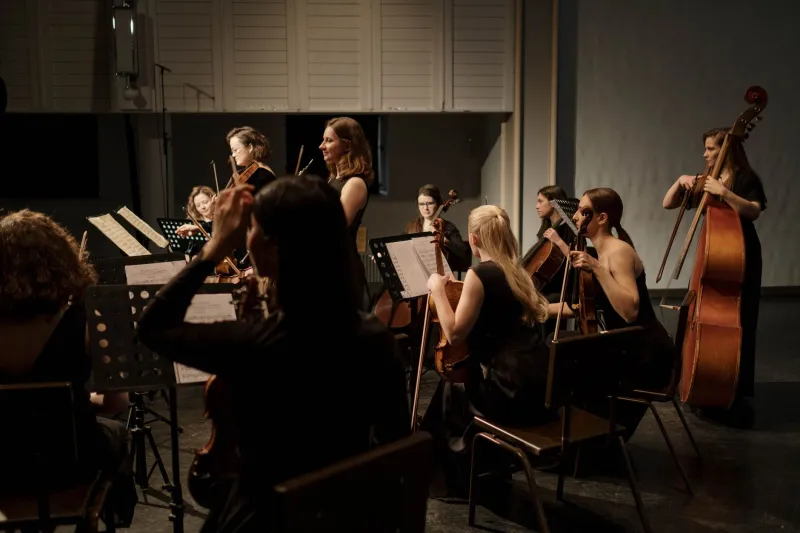
American orchestras have been alert to this phenomenon, and many have moved with uncharacteristic swiftness to capitalize on it. The programming of film music at symphony concerts is no longer confined to the summer pops season. Institutions that once regarded such offerings as a necessary commercial concession are increasingly integrating film composers' concert works into their main subscription seasons, presenting them not as accessible alternatives to serious music but as serious music in their own right.
The Los Angeles Philharmonic, operating in the city where so much of this music is made, has been particularly nimble in this regard, commissioning works from composers who straddle the film and concert worlds and presenting them in contexts that signal unambiguous artistic seriousness. Other major orchestras — in Chicago, Boston, and Washington, D.C. — have followed with varying degrees of enthusiasm, though the direction of travel is unmistakable.
The Audience Question
The demographic implications of this crossover are, from the perspective of orchestral institutions facing chronic concerns about audience aging, nothing short of extraordinary. Survey data gathered by several major American orchestras in recent seasons has consistently shown that film music programming draws measurably younger audiences — and, crucially, that a meaningful proportion of those first-time attendees return for subsequent concerts featuring more traditional repertoire.
This is the outcome that arts administrators have sought, largely unsuccessfully, through decades of various outreach initiatives. The insight that film composers have inadvertently provided is that the barrier to classical concert attendance was never primarily one of musical complexity or cultural intimidation. It was one of relevance — of audiences being unable to locate themselves in the emotional landscape of the music being offered. When that landscape is familiar, when the orchestral forces are deployed in service of themes and textures that listeners already carry within them, the concert hall ceases to feel like a foreign country.
"People don't come to hear film music and then leave thinking they've attended a lesser version of a classical concert," noted one programming director at a major Midwestern symphony. "They leave having had a profound orchestral experience, and they want more of it. That's the whole game, isn't it?"
The Artistic Stakes
Not everyone is sanguine about these developments. Some critics and musicians have expressed concern that the embrace of film composers by classical institutions represents a capitulation to commercial pressures rather than a genuine artistic evolution — that orchestras are, in effect, renting their prestige to popular culture in exchange for ticket sales.
These concerns deserve to be taken seriously, not least because the history of classical music institutions contains cautionary examples of programming decisions made in the name of accessibility that ultimately served neither artistic integrity nor long-term audience development. The question of where the line falls between genuine artistic crossover and mere commercial opportunism is one that each institution must answer for itself, and the answers will not always be comfortable.
Yet the compositions themselves argue against easy dismissal. Göransson's score for Oppenheimer, performed in its full orchestral form, reveals a structural sophistication and emotional intelligence that would not be out of place in the work of any contemporary concert composer. Zimmer's use of extended techniques, unconventional instrumentation, and architectural patience in building musical tension reflects a serious engagement with the full resources of the orchestra that no serious listener can simply wave away.
A New Movement Takes Shape
What is emerging, in the American concert hall as in the broader cultural conversation, is something that might be described as a new movement in classical music — one defined not by stylistic uniformity but by a willingness to dissolve inherited boundaries and to ask, without condescension, what orchestral music can mean to people whose lives are saturated with sound in ways that would have been unimaginable to earlier generations.
The composers at the vanguard of this movement did not set out to save classical music. They set out to write the most powerful music they could for the films they were given. The fact that their work has found its way into concert halls and into the hearts of audiences who had never previously thought of themselves as classical music listeners is, in the most precise sense of the word, a development worth celebrating.
The orchestra, it turns out, needed no saving. It needed only a new set of stories to tell.