The Eloquence of Empty Space: How Restraint Is Becoming Classical Music's Most Radical Statement
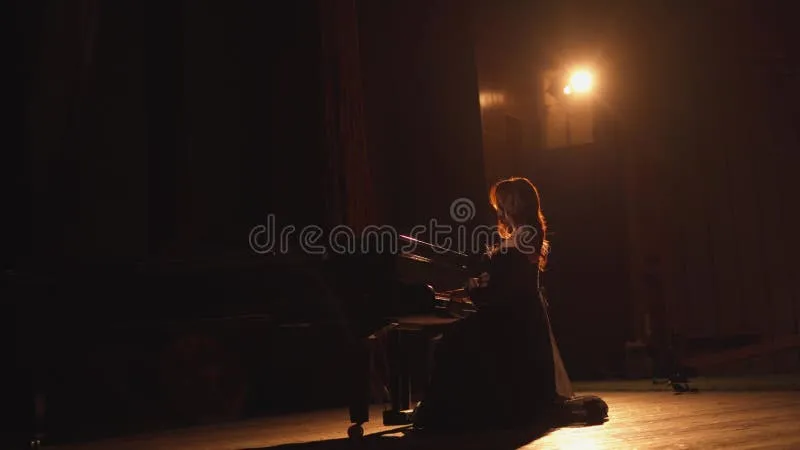
Photo: pianist performing alone on stage dramatic spotlight minimal concert hall, via thumbs.dreamstime.com
There is a moment in a truly great performance when the music stops — not because a movement has ended, but because the composer or performer has chosen, deliberately and courageously, to say nothing. The hall holds its breath. The audience leans forward. And in that suspended fraction of a second, something irreversible happens: the listener is pulled inward, made complicit in the music's meaning in a way that no torrent of notes could ever accomplish.
This is the phenomenon that a new generation of American classical musicians is not merely acknowledging but actively cultivating. Across recital halls, conservatories, and recording studios from New York to San Francisco, a philosophical shift is underway — one that prizes restraint over abundance, negative space over saturation, and the considered rest over the effortful flourish.
A Departure from the Maximalist Tradition
For much of the nineteenth and early twentieth centuries, Western classical music operated under an implicit assumption: more was more. The Romantic era, in particular, celebrated excess as a virtue — swelling orchestrations, virtuosic cadenzas that stretched for minutes, and dynamic ranges that seemed engineered to overwhelm. Mahler wrote symphonies requiring a small army of performers. Wagner conceived operas that lasted the better part of a day. The measure of greatness, in many circles, was magnitude.
Yet even within that tradition, dissenting voices were present. Composers such as Erik Satie and, later, Morton Feldman built careers on the proposition that music breathes most freely when given room to do so. Feldman, the Brooklyn-born experimentalist whose late works could unfold over five or six hours at the quietest possible dynamic levels, once remarked that he was not composing music so much as framing silence. His work was for decades considered an outlier — eccentric, even willfully obscure. Today, it reads increasingly like prophecy.
The Performer's Perspective
For contemporary interpreters, the embrace of negative space is less a stylistic choice than a philosophical conviction. Many describe arriving at this understanding only after years of training that emphasized technical mastery and expressive volume. The realization, when it comes, tends to feel like a release.
The argument, stated plainly, is this: when every measure is filled with sound, the listener's attention has nowhere to rest and nothing to anticipate. Musical tension requires the possibility of its own absence. A rest is not a pause in meaning — it is meaning. The silence after a phrase does not interrupt the emotional arc; it extends and deepens it, allowing what has just been played to resonate in the listener's imagination rather than being immediately displaced by the next event.
This is a principle long understood in other artistic disciplines. Painters speak of negative space — the area around and between subjects — as structurally essential rather than incidental. Architects design rooms in which emptiness is load-bearing. Even in literature, the white space on a page, the unfinished sentence, the withheld revelation, can carry more narrative force than paragraphs of explanation. Classical music is arriving, perhaps belatedly, at the same understanding.
Minimalism's American Lineage
It is worth noting that the United States has its own distinguished tradition of musical restraint, one that has rarely received the institutional veneration it deserves. The American minimalist composers of the mid-twentieth century — Steve Reich, Philip Glass, Terry Riley, and La Monte Young among them — developed a vocabulary of repetition, gradual transformation, and deliberate stasis that was, at its core, an argument for listening differently. Their work demanded that audiences relinquish the expectation of constant novelty and instead attend to subtle shifts within apparent stillness.
That tradition is now exerting a renewed influence on performers who were trained primarily in the European canon. Young pianists and chamber musicians speak of returning to the Reich and Glass scores they once dismissed as peripheral and finding in them a model for the kind of concentrated, unhurried attention they wish to bring to Schubert or Beethoven. The lesson is not that classical standards should sound like minimalism, but that the minimalist discipline — the willingness to trust silence, to resist filling every available space — can transform the way any music is heard.
Silence as Interpretive Choice
In practical terms, the shift toward negative space manifests in decisions that might seem minor but prove transformative in performance. A pianist who chooses not to use the sustain pedal through a lyrical passage allows individual notes to decay naturally, creating gaps that give the melody an almost vocal quality — the sense of a speaker pausing to breathe, to gather thought. A string quartet that observes a written rest with absolute stillness, rather than subtly preparing for the next entrance, turns that rest into a structural event rather than a typographical convention.
These are choices that require considerable confidence. The instinct, particularly in high-stakes performance settings, is to fill silence — to keep moving, keep producing, to demonstrate that one is present and capable. Choosing not to is an act of artistic courage, one that trusts the audience to remain engaged without being continuously stimulated.
There is also a communicative dimension that performers find compelling. When a musician allows a phrase to end and then waits — genuinely waits, without telegraphing what comes next — the audience is invited into a shared moment of uncertainty. That uncertainty, brief as it may be, is where emotional connection lives. It is the musical equivalent of a pause in conversation before a difficult truth is spoken: the silence itself signals that what follows will matter.
The Audience's Role
This approach asks something of listeners as well. American concert culture has, in recent decades, grappled with questions of accessibility and engagement — how to draw new audiences, how to make classical music feel relevant rather than ceremonial. The answer, some argue, has been to program more, explain more, add more contextual scaffolding. The minimalist counterargument is that audiences are more than capable of sitting with silence if they are given permission to do so.
There is evidence to support this view. Performances that incorporate extended quiet passages — whether in new compositions or in reinterpreted standard repertoire — frequently generate the most intense post-concert conversation. Audiences do not leave confused or disappointed; they leave having experienced something they struggle to articulate, which is precisely the territory that great art occupies.
What Remains
The turn toward restraint in classical music is not an abandonment of expressiveness. It is, rather, a recalibration of what expressiveness means — a recognition that the most affecting moments in performance are often those in which the performer steps back and allows the music to exist in space without intervention.
The scarlet thread running through the finest classical performances has never been sheer volume or technical density. It has been intention: the sense that every choice, including the choice to remain silent, has been made in service of something larger than display. In that sense, the embrace of negative space is not a departure from the classical tradition. It is, perhaps, its most faithful expression.