Movement Unbound: When Classical Composition Finds Its Voice in Unexpected Places
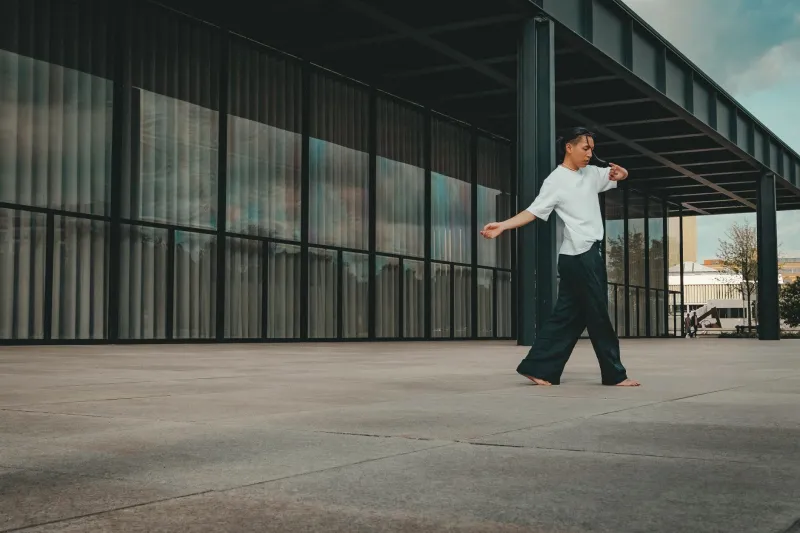
A new wave of choreographers is carrying classical music out of the concert hall and into the streets, galleries, and green spaces of American life — giving ancient compositions an urgent, embodied presence. From warehouse galleries in Detroit to sunlit plazas in Washington, D.C., interpretive dance is forging a visceral connection between classical sound and contemporary movement that traditional stages have rarely achieved. The result is something both radical and deeply reverent.
The Stage Is Everywhere
There is a particular quality of attention that descends upon an audience when a dancer moves through an unexpected space. Without the architectural cues of a proscenium arch or the darkened hush of a theater, the viewer is stripped of the usual protocols — the programs, the assigned seats, the polite distance. What remains is the work itself, unmediated and immediate.
This is precisely the condition that a growing cohort of American choreographers is seeking to create. Working at the intersection of classical music and site-specific performance, they are staging interpretations of Debussy, Satie, Arvo Pärt, and Bach in locations that would have struck previous generations as unthinkable: industrial warehouses, botanical gardens, rooftop terraces, and the open galleries of contemporary art museums.
The impulse is not iconoclasm. These artists are not rejecting classical music's grandeur — they are relocating it, insisting that its power does not depend upon the legitimizing architecture of the concert hall.
Reimagining the Repertoire
Among the most compelling examples of this movement is the work of New York-based choreographer Solène Arcand, whose company has staged site-specific responses to Satie's Gymnopédies in a series of unconventional venues across the Northeast. A recent iteration took place in a former textile mill in Providence, Rhode Island, where the building's exposed brick and residual industrial machinery became a kind of set design — one that Arcand neither disguised nor apologized for.
"Satie wrote music that lives in the space between notes," Arcand explained during a conversation with Scarlet Valse. "When you perform it in a traditional concert setting, the audience knows how to receive it. They apply their existing frameworks. But when you put a dancer in a space that carries its own history, its own weight, the music becomes something new. The audience has to figure out what they are witnessing. That uncertainty is productive."
The dancers in Arcand's company move with a quality of deliberate restraint — long, weighted gestures that seem to absorb the sound rather than illustrate it. The effect is less theatrical than contemplative, and audience members have described the experience in terms more commonly associated with visual art or meditation than performance.
Museums as the New Concert Hall
Art museums, with their existing commitment to aesthetic experience and cultural curiosity, have proven to be particularly fertile ground for this kind of work. The Art Institute of Chicago, the Hammer Museum in Los Angeles, and the Isabella Stewart Gardner Museum in Boston — which has hosted chamber performances within its courtyard for decades — have all recently expanded their programming to include dance responses to classical works within their gallery spaces.
At the Gardner, a recent collaboration between a Boston-based contemporary dance ensemble and a string quartet placed performers among the museum's permanent collection, with Baroque compositions providing the sonic framework for movement that wove between Flemish paintings and Renaissance sculpture. Visitors who arrived intending to view the collection found themselves inside a performance; those who came for the performance found themselves in an unexpected dialogue with five centuries of visual art.
"The boundaries between the disciplines dissolved in a way that felt entirely natural," recalled Marcus Webb, a 34-year-old architect who attended the Gardner event without prior knowledge of the performance. "I had never been particularly moved by classical music before. But watching someone move to it in that space — surrounded by all of that beauty — I understood something I had never understood before."
His testimony is representative of a broader phenomenon: the non-traditional setting appears to lower the psychological threshold for engagement, allowing audiences who might feel intimidated by a formal concert hall to encounter classical music on more neutral emotional territory.
Public Space and the Politics of Beauty
If museums represent one frontier, public space represents another — and a more politically charged one. Performances staged in parks, plazas, and transit hubs carry an implicit argument: that classical music and the dance it inspires belong to everyone, not merely to those with the means and cultural fluency to navigate traditional venues.
The Washington, D.C.-based collective Resonance in Motion has built its entire practice around this premise. The group stages unannounced or lightly advertised performances in public spaces throughout the capital, pairing live classical musicians with dancers who respond to the music in real time. The audiences that gather are self-selecting in the most organic sense — passersby who pause, curious, and find themselves drawn into an experience they did not seek.
"We are not trying to bring classical music to the people as though it were a charitable act," said collective co-founder James Okafor. "We are asserting that it was always theirs. The concert hall is a relatively recent invention. Music and movement in public space is as old as human culture."
The collective's performances have attracted audiences as demographically varied as the city itself — a fact that Okafor notes with quiet satisfaction.
Reverence Without Walls
Critics of this movement occasionally raise the concern that removing classical performance from its traditional context risks trivializing the work — that the informality of a park or gallery diminishes the focused attention that complex compositions demand. It is a concern worth taking seriously. Not every piece of music is served by every context, and the choreographers working in this space are, at their best, acutely attentive to the relationship between repertoire and setting.
But the most compelling argument for this work is not theoretical — it is experiential. Audiences who encounter interpretive dance set to classical music in a sunlit garden or a candlelit gallery frequently describe a quality of attention that rivals, and sometimes exceeds, what they have felt in formal concert settings. Freed from the pressure to perform their own cultural sophistication, they are simply present.
In this sense, the movement is not a departure from classical music's deepest aspirations. It is a return to them — a reminder that the purpose of great art is not to consecrate the spaces it inhabits, but to illuminate the people who encounter it, wherever they happen to stand.