The Eloquence of Nothing: How Classical Performers Are Turning Silence Into the Most Powerful Note of All
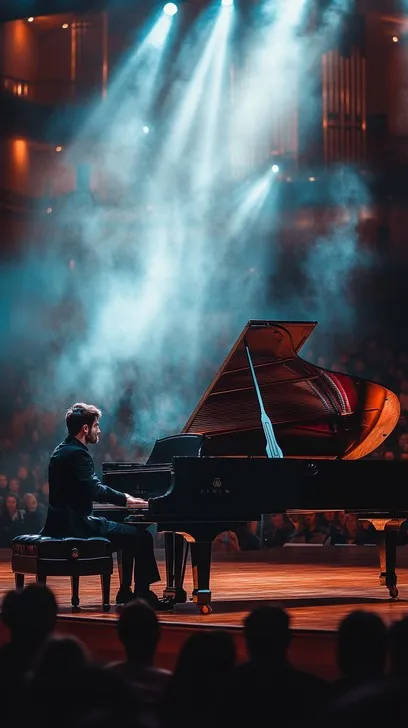
Photo: classical pianist dramatic pause concert hall performance, via images.stockcake.com
There is a moment, familiar to any devoted concertgoer, when an entire hall seems to stop breathing. The pianist's hands hover above the keys. The conductor's baton hangs suspended in the air. The orchestra has just released a phrase of extraordinary intensity — and then, nothing. The silence that follows is not empty. It is, in fact, almost unbearably full.
This is the phenomenon that a growing number of America's most distinguished classical performers are not merely acknowledging but actively cultivating. The deliberate pause — once regarded primarily as a technical matter of phrasing or breath — has been elevated into something far more consequential: a vehicle for emotional communication that rivals, and at times surpasses, the music itself.
A Language Written in Rests
To understand why silence has taken on such renewed significance, it helps to consider what most audiences unconsciously expect from a classical performance. They arrive anticipating sound — an uninterrupted stream of carefully organized notes that will carry them from opening bars to final cadence. The performer who understands this expectation, and chooses to subvert it with precision, holds a remarkable power over the room.
Violinists, pianists, and chamber musicians across the country have spoken in recent seasons about a shift in how they approach these moments. Rather than treating rests as gaps to be navigated, many now describe them as the very architecture of emotional meaning. A pause placed just before a recapitulation does not merely mark a structural boundary — it creates anticipation so acute that when the theme returns, its arrival feels almost physically overwhelming.
The conductor Marin Alsop, long celebrated for her interpretive depth with the Baltimore Symphony Orchestra, has spoken publicly about her belief that silence is a form of musical argument. To allow an audience to sit inside a pause — to resist the impulse to fill every moment with motion — is, she has suggested, an act of profound trust in both the music and the listener.
The Psychology of the Held Breath
What occurs neurologically during these moments of orchestrated quiet is, by now, reasonably well understood. Research in music cognition has demonstrated that the human brain does not simply switch off during a rest. Instead, it continues to process the emotional trajectory of the preceding phrase, effectively completing the musical thought in an interior space. A performer who understands this process can use silence to direct that internal completion — steering the listener's emotional response as surely as any written passage.
This is precisely what separates a strategic pause from a merely accidental one. The pianist who lingers at the summit of a Brahms intermezzo before descending into the final measures is not pausing because the music demands it technically. He or she is pausing because the emotional logic of the piece — and, crucially, the emotional readiness of the audience — requires it. The silence becomes a kind of unwritten notation, a message passed directly between performer and listener without the mediation of sound.
Young performers studying at conservatories from the New England Conservatory in Boston to the San Francisco Conservatory of Music report that their teachers are increasingly attentive to this dimension of musicianship. The question is no longer simply whether a student can execute a passage cleanly, but whether they possess the confidence and sensitivity to hold a silence without flinching — to resist the anxiety that compels so many performers to rush onward before the moment has fully resolved itself.
The Courage of Stillness
There is, it must be acknowledged, something genuinely demanding about this practice. Silence on a concert stage is exposed in a way that sound never quite is. A note, however imperfect, provides cover. A pause offers none. The performer who chooses to dwell in silence is, in a very real sense, asking the audience to dwell there alongside them — to remain present, suspended, and trusting.
For many instrumentalists, learning to inhabit these moments without apology has required a fundamental shift in self-perception. The performance is no longer a monologue delivered from the stage. It becomes, instead, a dialogue — one in which the audience's collective breath, their leaning forward in their seats, their held stillness, constitutes a form of response that the performer can sense and, in turn, respond to.
Cellist Alisa Weilerstein has described this dynamic in terms that resonate deeply with anyone who has experienced it from either side of the footlights. The silence after a particularly exposed phrase, she has noted, carries the emotional weight of everything that was just said. To cut it short is to deny the music its full meaning. To honor it — to stand inside it without rushing toward resolution — is to allow the piece to complete itself in the listener as well as the performer.
When Concert Halls Become Cathedrals
The broader cultural context of this development is worth considering. American audiences, accustomed to a media landscape that prizes constant stimulation and abhors dead air, arrive at the concert hall carrying habits of attention that are, in many respects, antithetical to the experience of sustained silence. The classical performer who successfully draws those same audiences into a moment of profound quiet has accomplished something that extends beyond musical interpretation.
Venues such as Carnegie Hall in New York, Symphony Hall in Chicago, and Davies Symphony Hall in San Francisco become, in these moments, something approaching sacred spaces — not in any narrowly religious sense, but in the older meaning of the word: places set apart from ordinary time, where a different quality of attention becomes possible.
This is, perhaps, the most compelling argument for the cultivation of silence as an expressive tool. In an era when the competition for human attention has never been more fierce, the classical performer who can make two thousand people stop, hold their breath, and feel something in the space between notes is doing something genuinely extraordinary. Not despite the silence, but because of it.
The Note That Isn't There
The great pianist Artur Schnabel, reflecting on his art many decades ago, observed that the notes he played were no better than those played by many others, but that the pauses between the notes — those, he suggested, were something else entirely. The remark has been quoted so frequently that it risks becoming a cliché. But the musicians now working most seriously with silence would argue that Schnabel's insight remains not only valid but more urgently relevant than ever.
In the hands of a performer who truly understands its power, silence is not the absence of music. It is music's most concentrated form — the point at which everything that has been played is distilled into a single, breathless instant of shared feeling. The curtain, in those moments, does not fall. It simply pauses, trembling, before the next act of revelation begins.